Anti Crypto
@microchipgnu
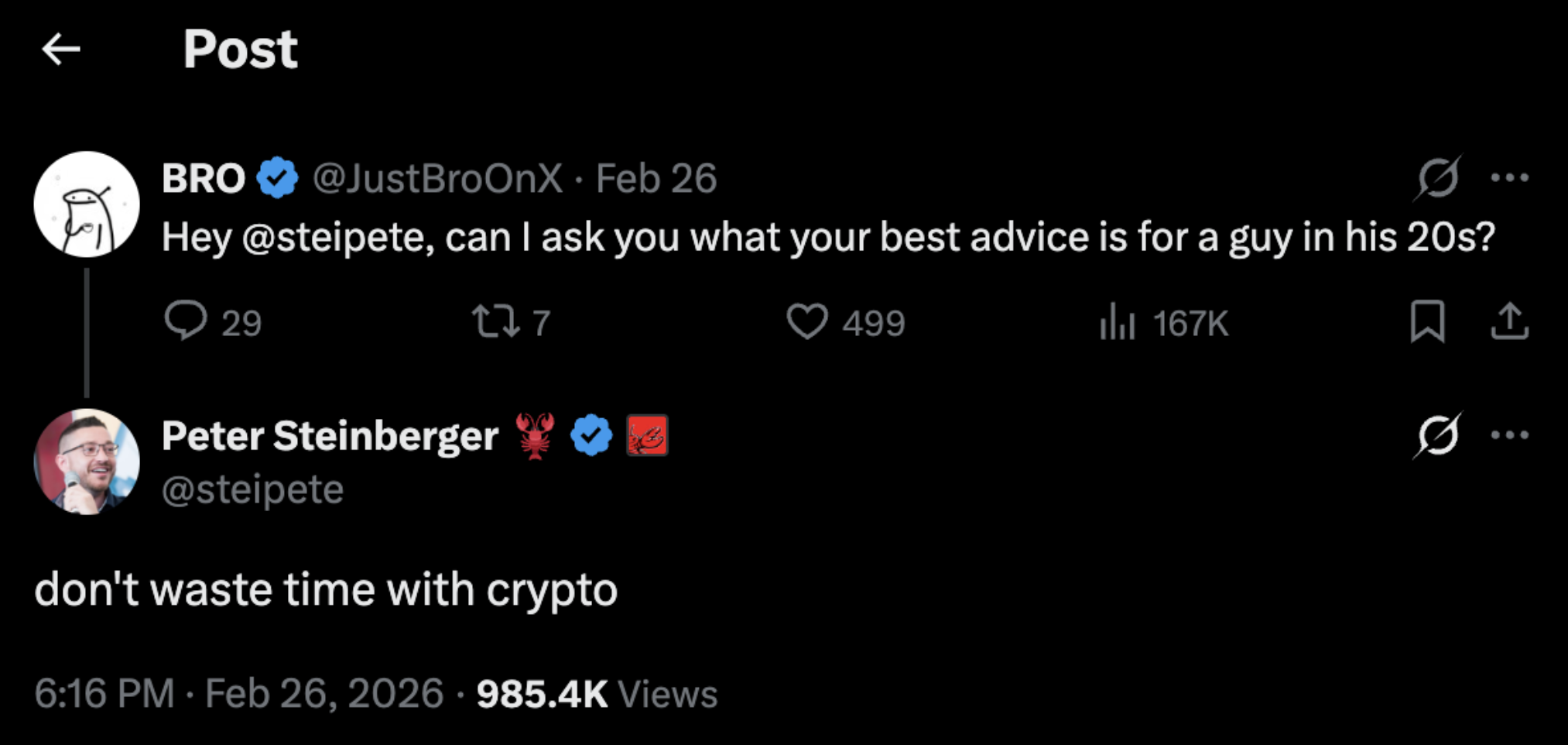
Welcome everyone. This talk is about what I learned spending my entire 20s building in crypto, and why I think everything we built was for the wrong user. Peter Steinberger built PSPDFKit, raised 100M+ from Insight Partners, then built OpenClaw. Someone asked him for life advice on X. Almost a million people saw this answer. Then scammers launched a fake token in his name and harassed him. That's crypto's surface layer. Who is this guy?
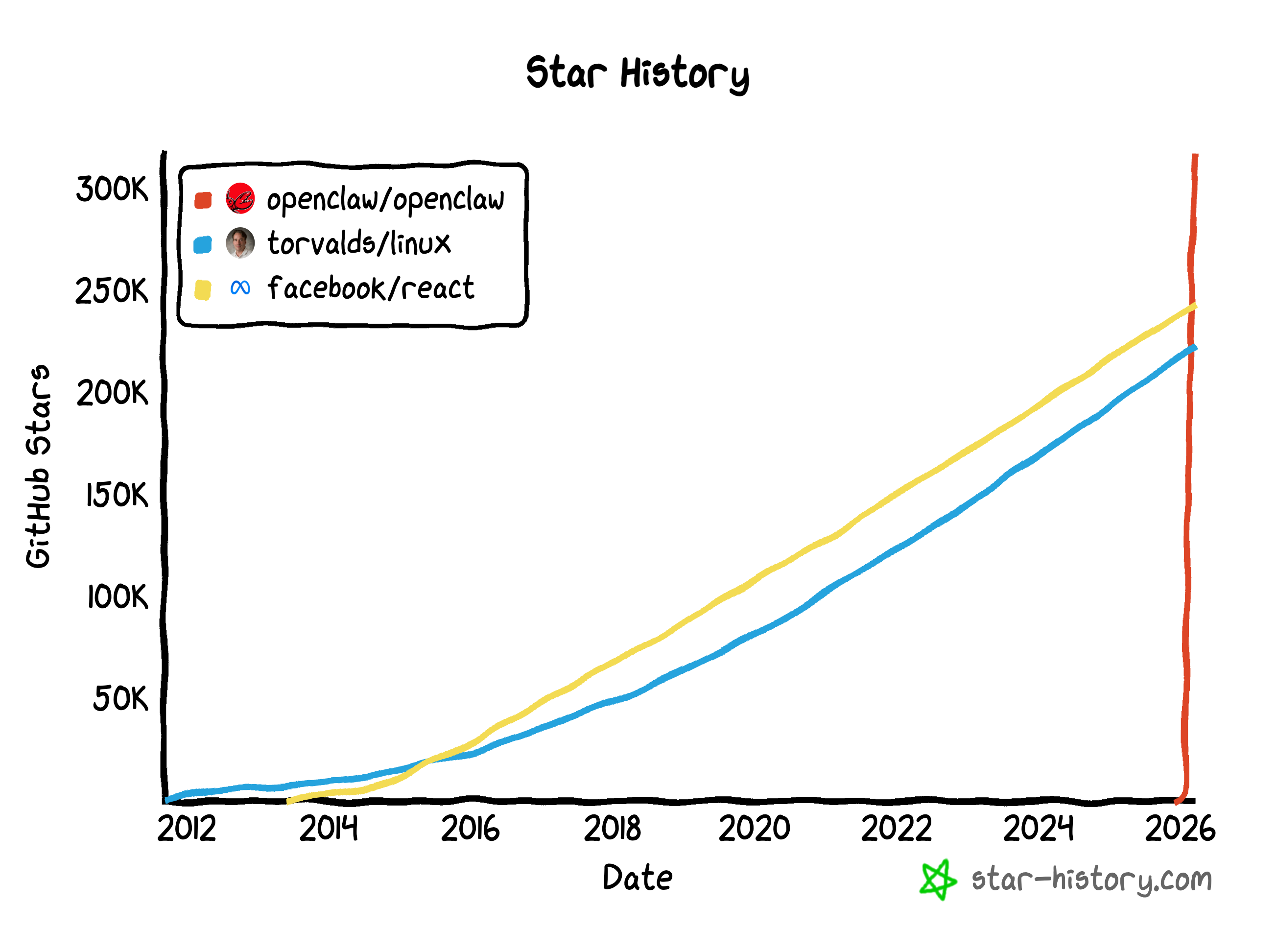
Built PSPDFKit. Raised €100M+ from Insight Partners.OpenClaw , now the fastest-growing open-source project on GitHub.
This is not some random person. Peter built PSPDFKit into a market leader, raised 100M+ from Insight Partners, and then built OpenClaw which surpassed Linux and React in GitHub stars. When someone with this track record says "don't waste time with crypto," it carries weight. Almost a million people saw it. At first I was shocked.
Then annoyed.
Then I couldpartly agree .
My honest reaction. I spent my 20s in this space. If you spent them trading, yes, probably wasted. If you spent them building, you learned distributed systems, cryptography, incentive design, and how to ship products to zero users for years. That's specific training very few people have. Lisbon, 2016
Broke college student.over a beer .
He was up 3x. But then he said: "The technology might interest you."
Arco do Cego, Lisbon. Working on my master thesis at Técnico. No money, lots of time. My friend was up 3x in a few weeks but the important thing was he said the tech was interesting. That led me to the Ethereum whitepaper. Vitalik wrote it when he was 19. Discovery
The first thing that excitedmaking money .
It was saving money .
Deploy once. Users pay for compute. As a broke student, that idea was everything.
Cloud was expensive. With Ethereum, you pay once to deploy, then users pay for compute when they use it. As a broke student, this was revolutionary. The entire industry then spent 8 years optimizing for financial outcomes instead of product ones. My story is the arc of that divergence. But...
Imagine paying everyopen a .
That's what blockchains asked users to do.
The industry thought this was a feature. For seven years.
Gas fees. Every click costs money. You need to understand wallets, private keys, gas limits, gas prices, network congestion before using even the simplest app. The principle is right: someone has to pay for decentralized compute. But it was a massive UX problem. It would take a completely different type of user, a non-human one, before this made sense. The pattern
Every cycle promised something real
ICOs (2017)
Programmable fundraising.
Anyone can raise capital globally.
$8.2B raised in 2017
DeFi (2020)
Composable finance.
Lend, borrow, trade without banks.
$15B TVL in 6 months
NFTs (2021)
Digital ownership.
Provable scarcity on the internet.
$25B volume in 2021
Metaverse (2021)
Spatial web.
Digital worlds with real economies.
$3T market cap peak
Real breakthroughs. Real technology.
Each cycle had a genuine technical achievement. ICOs raised $8.2B in 2017 alone. DeFi went from under $1B to $15B TVL in 6 months. NFTs did $25B in volume. The total crypto market cap hit $3 trillion. These aren't fake numbers. Real money, real technology, real adoption curves. But...
Every cycle went wrong the same way
ICOs
80% identified as scams.
86% below ICO price within a year.
Bitconnect. OneCoin. EOS.
DeFi
10,000% yield farms.
Ponzinomics dressed as innovation.
98% of food farms dead
NFTs
JPG speculation.
Right-click save was a fair point.
Market down 95% from peak
Metaverse
Empty virtual real estate.
Hundreds of concurrent users.
Meta walked it all back
Same breakthroughs. Wrong user.
But every single cycle went wrong the same way. ICOs: 80% scams, 86% below ICO price within a year. DeFi: recursive yield farming, ponzinomics. NFTs: spectacle over utility, market collapsed 95%. Metaverse: empty worlds, Facebook renamed itself for nothing. The pattern is always the same: real technology, pointed at the wrong user. Mintbase, 2018 - 2021
We built utility NFTs for three years.
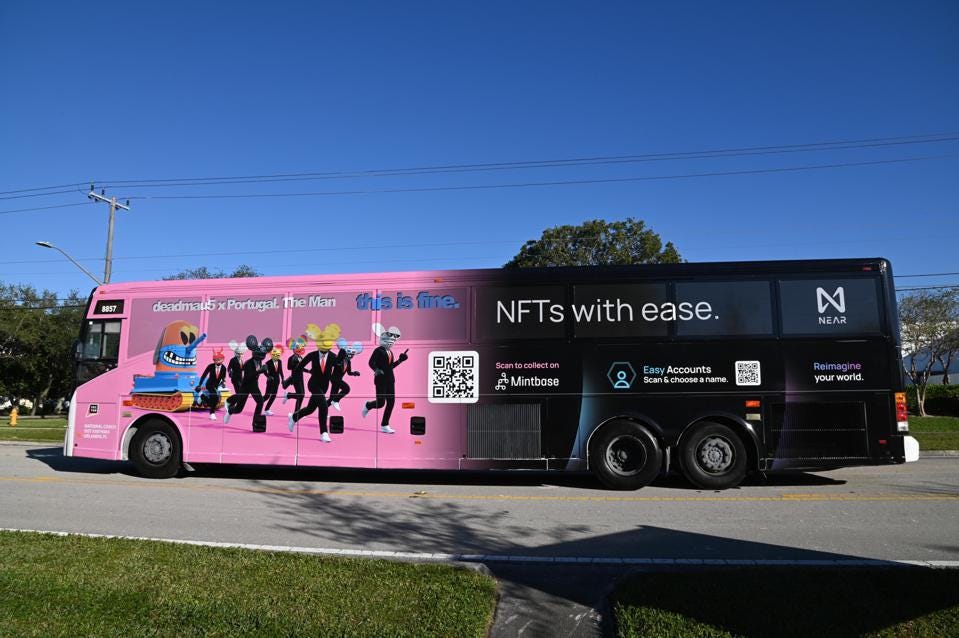
Until we did a collection with Deadmau5 . 1M NFTs minted.
The market didn't want utility. It wanted spectacle.
I was an engineer at Mintbase since 2018. We were building utility NFTs: tickets, access passes, things you actually use. The market ignored us for 3 years. When we finally got traction, it wasn't because our thesis won. It was because of a celebrity partnership. We processed 1 million NFTs with Deadmau5. We were right about what NFTs could be, but the market only showed up for cultural speculation. You can betechnically right
This connects directly to Peter's tweet. You can build the right thing for years, be technically correct, and still feel like you wasted your time because the market never met you where you were. That's the builder's version of crypto frustration. @HooCrypto research, 2026
Crypto has a builder retention problem
Base tracks 40,000+ builders. Only ~500 rewarded per month.
"If you hand out money first, you attract people who want money first."
The industry optimized for acquisition, never retention.
This wasn't just my experience at Mintbase. Juampi (@HooCrypto) interviewed ecosystem leads across Base, Celo, BNB Chain, Fuel, Aave, Avail, Privy, and Starknet in early 2026. He found the same pattern everywhere. Ecosystems pour money into hackathons, grants, and bounties to attract builders, but most leave before shipping anything. Base tracks over 40,000 builders but only about 500 are rewarded in any given month. The PUSH Protocol co-founder summed it up: if you hand out money first, you attract people who want money first. same pattern, every cycle
What kept failing
Hackathon theater
Submissions + hype, near-zero retention
Grants as product
Builders optimize for the check, not the ship
Vanity metrics
Tracking attendance, not production
Scaling without filter
Top builders invisible, low-effort rewarded equally
Juampi documented the same anti-patterns across every ecosystem. Hackathon theater: events generate hype and submissions, but almost nobody keeps building after. This is the builder version of spectacle — same thing I experienced with NFTs. Grants as the product: when builders optimize for getting the grant rather than shipping. Aave's grants DAO showed both sides — grants can fund key infra, but spending easily exceeds value when there's no filter. Vanity metrics: tracking who showed up, not who shipped to production. Scaling without a filter: when everyone gets equal attention regardless of output, top builders feel invisible and leave. It's the same financialization trap, playing out on the builder side. Quality reveals itself
Not hackathon placements. Not grant applications.Shipping.
The deepest insight from Juampi's research. You can't predict builder quality from credentials. You can only observe it through behavior over time. The ecosystems making real progress were the ones measuring output instead of attendance. Base with retroactive builder rewards based on what people actually shipped. Privy tracking developers who moved from dev mode to production. The central tension is simple: ecosystems need reach to discover quality, but they need quality to create compounding outcomes. Almost none of them had solved that. And this was before AI tools made it possible for anyone to ship an app in days. The builder pool is about to get much bigger, and the retention problem much harder. $3T LUNA 3AC CELSIUS FTX $800B Terra / Luna $40B evaporated
Three Arrows Bankrupt
Celsius $4.7B frozen
FTX $8B missing
Uniswap never stopped. Ethereum never went down. Aave kept processing.
The protocols never crashed.People did.
2022 was crypto eating itself. Market went from $3T to under $800B. Terra collapsed through a death spiral. 3AC went bankrupt. Celsius froze $4.7B. FTX: $8B in customer funds missing, SBF sentenced to 25 years. But here's the thing: every decentralized protocol kept running. Uniswap, Ethereum, Aave. They never went down. The failures were human, not technical. You build the engine,"cars are dangerous."
That's the builder's frustration in one sentence. The infrastructure worked perfectly. The humans running centralized platforms committed fraud. And the headline is "crypto is a scam." You built the engine. Someone else crashed the car. Late 2022
Then ChatGPT arrived.
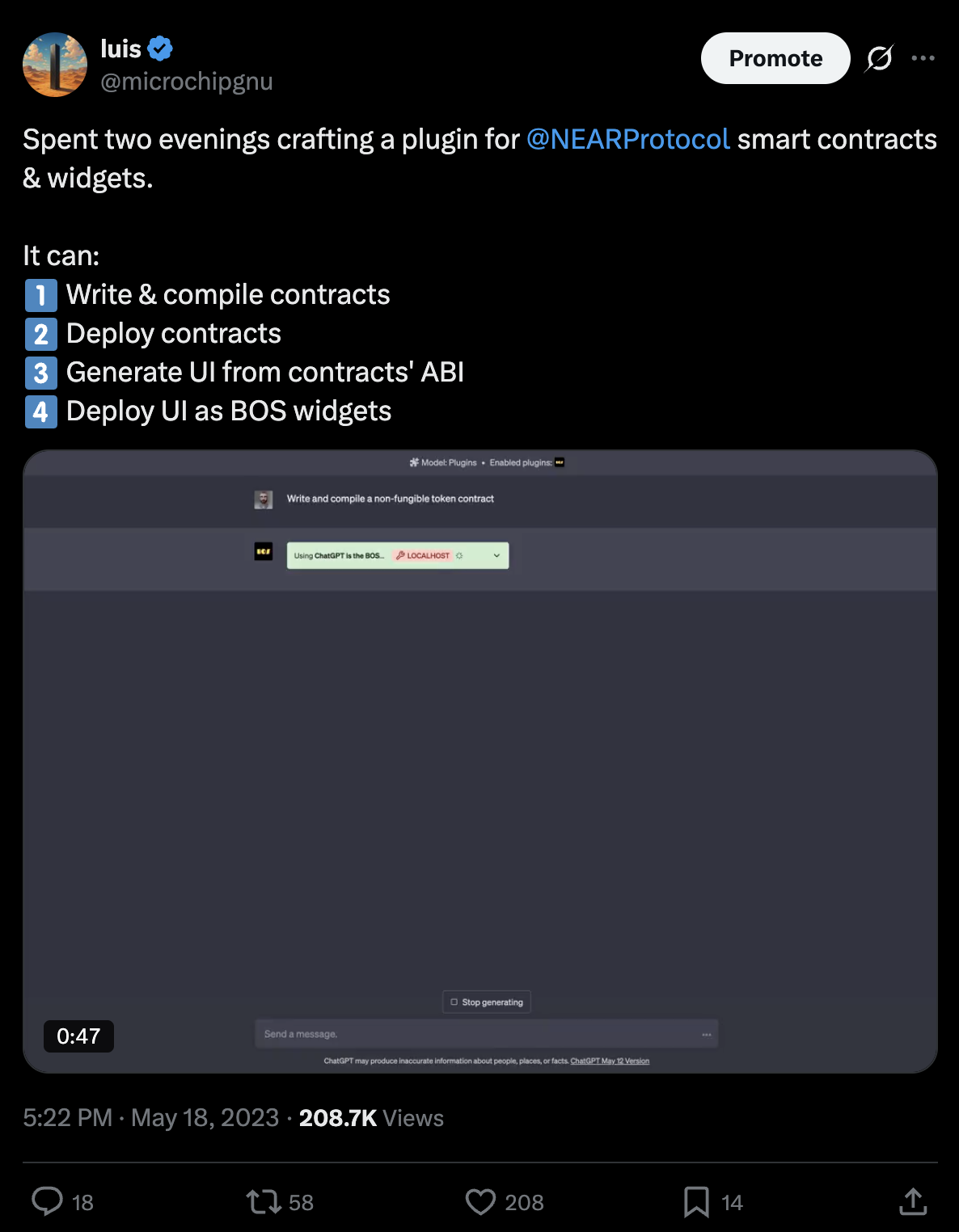
I built blockchain plugins for it.
OpenAI took them down .
"Financial plugins." Same lesson crypto taught for a decade: don't build on someone else's platform.
Function calling in early 2023 was the inflection point. AI models could trigger actions, call APIs, build transactions. I built ChatGPT plugins that constructed blockchain transactions. OpenAI removed them. "Financial plugins." They saw blockchain = finance = regulated = risk. That rejection pushed me to build independently. Same lesson crypto has taught for a decade: don't build on someone else's platform. Every crypto cycle wasright idea at thewrong user .
This is the core insight of the talk. Pause here. Let it land. Every cycle had a real breakthrough. Every cycle pointed it at humans who didn't want to deal with seed phrases and gas fees. The infrastructure always worked. The user hadn't arrived yet. AI agents don't mindwhat they do .
The gas problem I identified as a broke student finally has a natural resolution. AI agents don't need pretty interfaces. They don't need onboarding flows. They need programmatic access to payments, identity, and data. The UX problem that plagued crypto for 7 years wasn't a problem at all when the user was software. HTTP specification, 1997
402
Payment Required
"Reserved for future use"
Dormant for 28 years .
Now AI agents need to buy things.
HTTP 402 was written into the web spec in 1997 with four words: "reserved for future use." Credit cards won instead. Subscriptions dominated. 402 sat dormant for 28 years. Cloudflare now sends over 1 billion 402 responses per day to AI crawlers. Coinbase and Cloudflare shipped x402 for stablecoin micropayments over HTTP. The future use case arrived. x402 in action
AGENT SERVER 1 GET /api/search no auth, no API key, no account 2 402 Payment Required pay 0.003 USDC on Solana to 0xa1b2...c3d4 3 0.003 USDC sent wallet signs + broadcasts on-chain 4 200 OK + data delivered <1s receipt: 0xf3e4...a7b8 No account. No API key. No human. Just HTTP + Stablecoins .
Walk through each step. 1: Agent makes a normal HTTP request. 2: Server responds with 402 and payment details. 3: Agent wallet automatically signs and sends USDC on-chain. 4: Server verifies the receipt, returns the data. The whole thing takes less than a second. No signup, no API key, no subscription. $33T
Stablecoin settlement
$320B
Stablecoin market cap
Stripe launched x402 support. Then launched Tempo , their own blockchain, with Machine Payments Protocol. Same week: Visa CLI, Mastercard, Lightning Labs.
1 billion 402 responses per day from Cloudflare. $33 trillion in stablecoin settlement. $320B market cap. And then it accelerated: Stripe launched x402 support, then went further and launched Tempo with Paradigm — their own blockchain — with Machine Payments Protocol shipping day one. Raised over $500M. Visa, Klarna, 100+ services on board at launch. Same week: Visa shipped a CLI for AI agent transactions, Mastercard acquired stablecoin infra, Lightning Labs added MPP support to LND. Five separate teams shipped agent payment infrastructure in one week. The question isn't crypto vs traditional finance anymore. Everyone is building on these rails. But I've seen thisbefore .
Pause. Let the audience feel the pattern recognition. You just sold them the bullish case. Now pull back. Be honest. This is the most important beat in the talk. right now, on X
The pattern is forming
"x402 coins" tracked daily
Like DeFi food tokens in 2020
Tempo meme tokens 40x
3 days after mainnet launch
Ecosystem wars
BNB: "40K agents." Same energy as L1 wars.
Skeptics are sharp
"Solving a problem nobody has"
The pattern is unmistakable. x402 coins being tracked like DeFi food tokens. Tempo launched 3 days ago and meme tokens are already pumping 40x on it — same pattern as every new chain launch. BNB claiming 40,000 agents, ecosystem wars all over again. And barneyxbt saying bluntly: "solving a problem nobody has." These are real signals. Name them honestly. So what's different?
Less 100x .1x that compounds .
Previous cycles: imaginary value, hyperbolic returns.
Here's the honest answer. Previous cycles created hyperbolic financial upside precisely because the value was imaginary — ICO tokens with no product, NFTs with no utility, memecoins with no pretense. This cycle's upside is smaller because the value is real. Real value distributes more evenly and less dramatically than speculative value. That's the trade-off. Less hype, more substance. If I'm wrong, the infrastructure survives anyway, like it always does. If I'm right, agents quietly paying fractions of a cent for API calls will be bigger than any of the exciting cycles ever were. In 1999, $1.5T wentfiber .
That fiber powered YouTube, Netflix, and Zoom. The bubble was the business model for the infrastructure.
The telecom bubble analogy. $1.5 trillion went in. Most companies died. But they laid fiber under every ocean. That fiber powered the next 25 years of the internet. Crypto is the same pattern playing out now. The tourists left. The builders stayed. Sub-cent transactions, $320B in stablecoins, and now a new user that can't open bank accounts but needs to transact billions of times a day. frames.ag
Wallets and tools
Open payment rails that software actually wants to use.
Frames gives AI agents funded wallets with spend policies and a curated registry of paid tools. No API keys, no subscriptions. Agents pay per use via x402. That's it. Simple infrastructure for the new user. $ claude "research competitor pricing for our product launch,
scrape their landing pages, generate a comparison video,
and draft a go-to-market strategy doc"
Searching web for competitor data... exa-search $0.002
Scraping 12 landing pages... firecrawl $0.015
Generating comparison video... sora-v2 $0.12
Writing strategy doc... claude-opus $0.08
4 tools | 4 payments via Frames wallet | all txs on Solana confirmed
Done. competitor-analysis.mp4 + gtm-strategy.md saved.
Total: $0.217 | No API keys. No subscriptions. Just a wallet with a budget.
This is the real use case. A founder asks their agent to do competitive research, scrape pages, generate a video, and write a strategy doc. The agent calls 4 different paid tools, each one paid for automatically through the Frames wallet. Total cost: 21 cents. No API key setup, no subscription to any of those services. The agent just paid for what it needed and moved on. Growing. Early. Real usage.
These are live numbers. Almost 1,800 agents using Frames wallets, 92,000 transactions, $57K in volume, 200 active in the last 24 hours. This is early but it's real. Agents are paying for things today. I didn't waste my 20s.
I just didn't knowwho I was building yet.
@microchipgnu | read the essay
I spent my 20s learning how money moves through code, how trust works without intermediaries, and how to build products when nobody is using them yet. AI agents need all of that. I didn't waste my 20s. I just didn't know who I was building for yet. Thank you.